
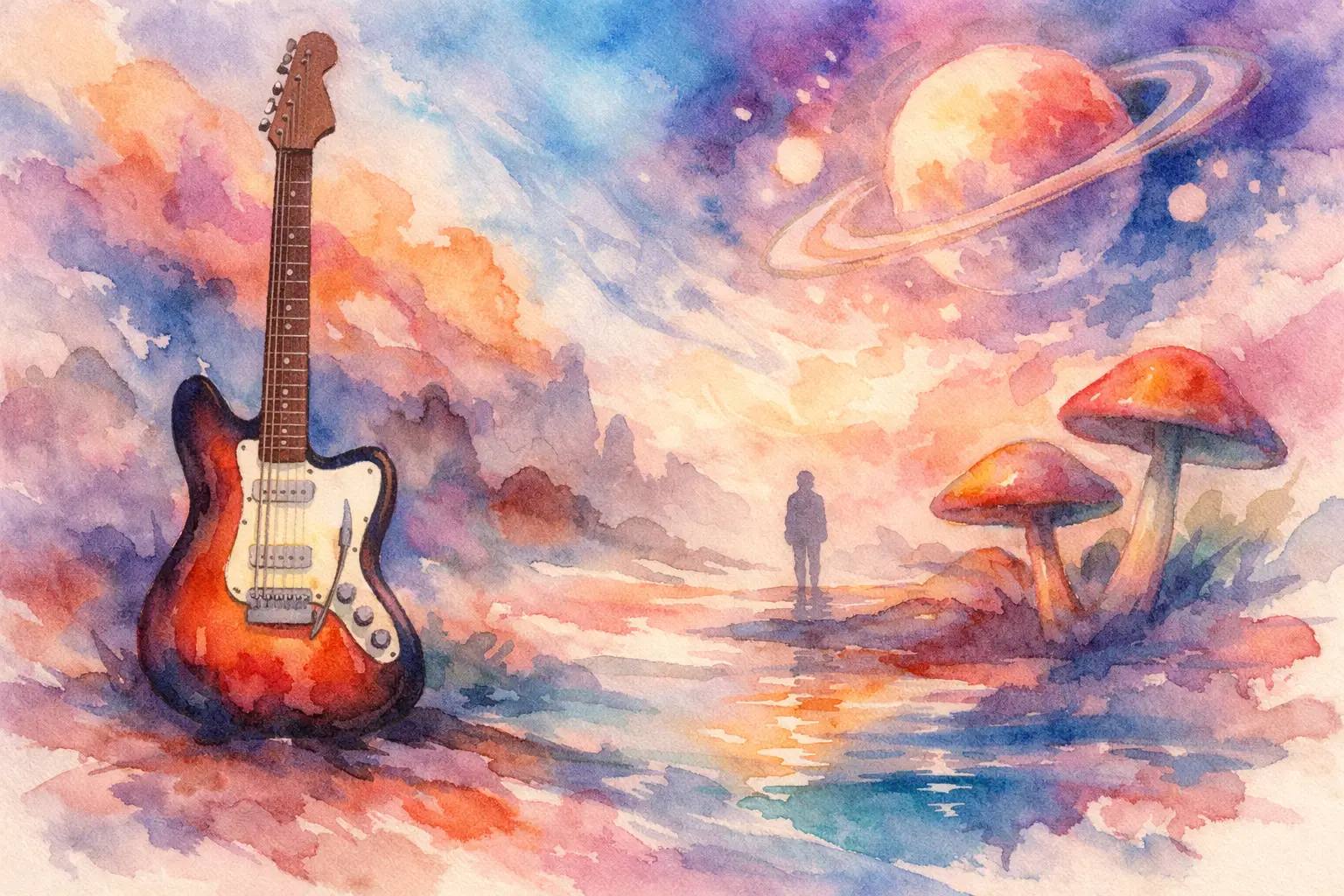
Some songs hit in under ten seconds. Others pull you in slowly, bending time, blurring edges, and making a three-minute track feel like a midnight drive through another state of mind. That space is where alternative rock with psychedelic influences earns its power. It does not rely on gimmicks or nostalgia. At its best, it turns mood into momentum and texture into meaning.
For listeners who want more than quick hooks and interchangeable production, this blend offers something lasting. It keeps the core tension and melodic force of alternative rock, then stretches it with atmosphere, tonal color, and a sense of motion that feels cinematic rather than formulaic. The result can be intimate, expansive, or slightly unsteady in the best possible way. It feels lived in.
Why alternative rock with psychedelic influences still matters
Alternative rock has always had room for outsiders, but psychedelic influence gives it a different kind of depth. It opens the arrangement. It lets a song breathe, drift, and build emotional weight without losing structure. Instead of pushing every instrument to the front, it often creates layers that reveal themselves over time.
That matters because modern listening habits can flatten music into background sound. When every track is built to grab attention instantly, subtlety gets treated like a weakness. But subtlety is often what creates loyalty. A song that leaves space for discovery tends to stay with people longer than one that gives away everything in the first chorus.
There is also a practical reason this sound remains compelling. It bridges generations. Fans of classic records hear echoes of adventurous studio craft, analog warmth, and fearless experimentation. Younger indie and alternative listeners hear mood-driven production, emotional ambiguity, and genre fluidity that fits how they already experience music. It is one of the few lanes that can feel timeless without sounding trapped in the past.
What defines this sound
The phrase itself can cover a lot of ground, so it helps to be specific. Alternative rock with psychedelic influences is not one fixed style. It is a framework. The rock foundation usually stays intact through song form, vocal presence, and guitar-based energy, while the psychedelic side changes how that foundation feels.
Sometimes that comes through effects – reverb, delay, modulation, reverse textures, and hazy vocal treatments that create movement around the central performance. Sometimes it shows up in harmony, with chords that lean dreamlike or unresolved rather than purely direct and aggressive. In other cases, the psychedelic quality comes from arrangement choices: drones under verses, elongated intros, shifting instrumental layers, or transitions that feel more like scenes than standard section changes.
Tempo also plays a role. Not every track in this space is slow, but many understand the value of restraint. A groove can be steady without being rigid. A chorus can arrive with lift instead of blunt force. That difference changes the emotional experience. You are not just hearing a song. You are entering it.
The balance between immediacy and atmosphere
This style works best when it knows what to hold back. If a track gets too abstract, it can lose the emotional center that makes alternative rock connect in the first place. If it stays too grounded and predictable, the psychedelic edge becomes decorative rather than essential.
The sweet spot is balance. Strong songwriting gives the listener something to hold onto – a vocal phrase, a chord progression, a melodic turn, a pulse that keeps the body engaged. The psychedelic influence then expands the emotional frame. It deepens the song instead of distracting from it.
That is why the strongest records in this lane tend to reward repeat plays. On the first listen, you catch the shape. On the second or third, you start hearing what the production is doing around that shape. The background guitar swell matters. The vocal echo changes the mood of a line. A subtle synth layer turns a chorus from solid to transportive. Nothing is accidental.
How production shapes the emotional impact
Production can make or break this kind of music. In straightforward rock, rawness alone can carry a track. In psychedelic-leaning alternative music, texture is part of the songwriting. The sound design is not just polish. It is narrative.
A dry vocal can feel confrontational and immediate. Add space around it, and the same lyric becomes more haunted, reflective, or surreal. A guitar part played clean and centered may sound sharp and direct. Run it through modulation and depth effects, and it begins to shimmer or drift, changing the emotional temperature without changing the notes.
There is a trade-off, though. Too much layering can bury the human element. Too much atmosphere can make a song feel vague. The most effective artists know when to let the arrangement bloom and when to strip it back to voice, rhythm, and melody. Restraint gives the immersive moments their weight.
For independent artists, this is especially important. You do not need a massive budget to build a compelling sonic world, but you do need intention. A focused arrangement, memorable vocal performance, and carefully chosen textures will often do more than a wall of effects. Listeners can hear the difference between artistic atmosphere and production clutter.
The listener experience is different by design
Not all music is built for the same kind of attention. Some records are built for quick impact, workouts, parties, or passive listening. Alternative rock with psychedelic influences tends to ask for a little more presence. Not because it is difficult, but because it is immersive.
That immersion is part of the appeal. These songs often fit moments when a listener wants mood, not noise. Late-night headphones. Long drives. Solitary walks. The hour after a crowded day when the mind finally slows down enough to absorb detail. This music understands emotional complexity and does not rush to simplify it.
That does not mean every track has to be melancholy or obscure. There is plenty of room for drive, volume, and release. But even the heavier or more immediate songs in this space often carry an undertow – a sense that there is something unfolding beneath the surface. That layered feeling is what separates memorable work from generic alt-rock with a few effects pedals thrown on top.
Why independent artists thrive here
This sound has always suited artists with a strong point of view. It rewards identity over trend chasing. That makes it a natural home for independent musicians who care about world-building, emotional precision, and artistic longevity.
Mainstream cycles tend to favor speed, repetition, and easily labeled formulas. Psychedelic-leaning alternative music does not always fit cleanly into those systems. That can be a disadvantage if the only goal is instant scale. It can also be a major advantage for artists building a lasting audience, because the listeners drawn to this sound are usually not casual. They follow records. They revisit songs. They care who made the music and why.
That is where independent credibility matters. When an artist develops original compositions with passion and excellence, the audience hears it. They hear the difference between borrowed aesthetics and a real body of work. They respond to records that feel authored rather than assembled.
For a professional recording artist, this lane offers real creative freedom. You can merge classic rock instincts with modern production. You can keep songs melodic while expanding their atmosphere. You can make work that feels personal and cinematic without sanding off its edge. That combination is part of what gives the genre its staying power.
Where the genre goes next
The future of this sound will probably be shaped less by genre rules and more by taste. Guitar music is no longer required to prove itself by being louder, dirtier, or more rigidly authentic than everything around it. That frees artists to be more selective. Some will lean into analog warmth and live-room energy. Others will fuse psychedelic textures with electronic detail, ambient transitions, or singer-songwriter intimacy.
The constant is emotional truth. If the song has a center, experimentation helps. If it does not, experimentation becomes camouflage.
That is the real promise of alternative rock with psychedelic influences. It gives artists room to stretch without losing the song, and it gives listeners something richer than surface-level impact. In a crowded landscape, that kind of music still stands apart because it respects attention and rewards feeling. If a track can do both, it does more than fill a playlist. It leaves a mark.