
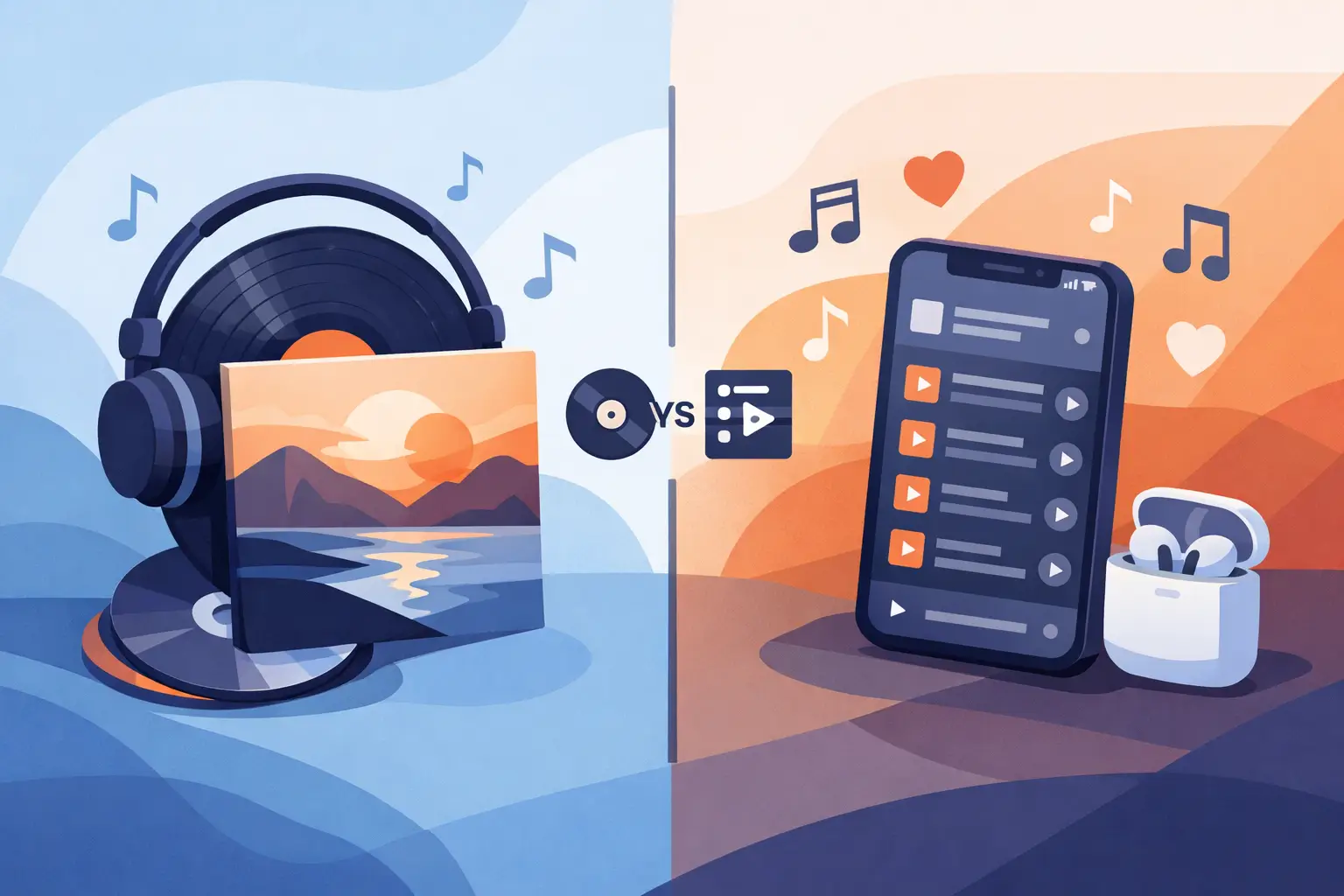
You can tell a lot about a listener by how they press play. Some want a sequence, a mood, a quick hit of energy that fits the moment. Others want to hear where a song came from, what came before it, and why the final track lands the way it does. That tension sits at the heart of album listening vs playlists, and it says a lot about how people connect with music now.
Neither habit is wrong. Playlists are useful, fast, and often genuinely great for discovery. Albums ask for more attention, but they can return something deeper – context, emotional architecture, and a stronger bond between artist and listener. For fans of indie rock, alternative music, and singer-songwriters, that difference matters because the music is often built with intention beyond a single track.
Album listening vs playlists: two very different experiences
A playlist is built for function. It can soundtrack a workout, a drive at night, a dinner party, or a rough week. It lets listeners jump between eras, genres, and artists without friction. That flexibility is one reason playlists became central to streaming culture. They match modern life because modern life is fragmented.
An album works differently. It is usually designed as a complete statement, even when the songs can stand on their own. The pacing matters. The order matters. The opening track sets a tone, the middle expands it, and the closing track often says what the artist could not say any other way. When listeners only hear one song out of sequence, they may get a strong track, but not the full emotional frame.
That is especially true in independent music, where artists often have more freedom to shape a project without chasing a radio formula. The album becomes more than a collection. It becomes a world with its own internal logic.
Why playlists became the default
Streaming trained people to think in moments rather than bodies of work. If you want songs for studying, late-night driving, heartbreak, or a summer weekend, a playlist gets there immediately. No commitment. No setup. Just press play.
There is real value in that. Playlists lower the barrier to entry for new artists. They can place an unknown song beside familiar names and give it a chance to connect fast. For listeners who are curious but short on time, playlists are often the first doorway.
They also reflect how people actually live. Not every listening session is sacred. Sometimes music needs to support the day instead of becoming the whole event. There is nothing shallow about that. Music has always had a social and practical role.
Why albums still matter
Albums slow the relationship down in a good way. They let a song mean more because it exists beside other songs, not in isolation. A quieter track may feel essential after a heavy one. A lyric might echo differently when it returns in another form three songs later. Themes emerge. Contrasts sharpen. The artist’s voice becomes clearer.
This is where album listening can be irreplaceable. It gives the listener access to intention. You hear not just what the artist made, but how they wanted it to unfold. That can reveal craft in a way playlists rarely do.
For music with cinematic textures, emotional depth, or narrative flow, the album is often the proper frame. A song pulled into a random mix may still work, but it loses some of its gravity. Context changes impact.
What album listening vs playlists means for artists
From the artist side, the difference is not abstract. It affects how music is written, released, and remembered.
A playlist-friendly track often has to make its case immediately. The hook arrives sooner. The mood is clear right away. The song has to survive distraction, skipping, and algorithmic competition. That pressure can sharpen a song, but it can also flatten risk. If every track has to win in the first seconds, nuance sometimes gets pushed aside.
Albums give artists room to build tension and trust the listener. They allow left turns, instrumental passages, recurring ideas, and songs that grow over time rather than announce themselves at full volume. For a professional recording artist invested in originality and longevity, that room matters.
It also shapes legacy. Listeners may save a playlist song for a season, but they often remember albums by era, by feeling, by who they were when they heard them. A strong album can become part of someone’s personal history. That kind of connection is harder to manufacture and harder to replace.
Discovery versus devotion
Playlists are excellent at discovery. Albums are better at devotion.
That may sound simple, but it explains a lot about current listening habits. A listener might first encounter an artist through one standout track on a mood-based playlist. If the song hits, the next step is not always another playlist. Often, it is the album. That is where curiosity turns into real fandom.
The album answers the question a single track cannot: was that one song a fluke, or does this artist have a point of view?
When the answer is yes, listeners stay longer. They follow releases. They buy music directly. They share songs with context instead of tossing them into the endless stream. For independent artists, that shift is huge. Casual exposure helps, but committed listeners build careers.
The trade-off most people feel but rarely name
Playlists offer breadth. Albums offer depth.
Breadth means more names, more sounds, more instant variety. Depth means stronger immersion and clearer artistic identity. Most listeners want both, but not always at the same time.
If you are hosting friends, cleaning the apartment, or working through emails, a playlist makes perfect sense. It supports the moment. If you are walking alone at night, taking a long drive, or giving a new artist a real chance, an album can do something playlists usually cannot. It can hold attention long enough to change your mood, sharpen your memory, or tell the truth in a more complete way.
That is the trade-off. Convenience tends to favor playlists. Meaning often favors albums.
Why some music suffers outside the album format
Not every song needs an album to work. Great singles have always existed. But some records are built around emotional progression, sonic contrast, or thematic tension. Break them apart, and the design weakens.
Think about an album that opens with restraint, grows into conflict, then resolves with a track that feels earned. If you only hear the middle song on a playlist, you may like it, but you miss the narrative pressure around it. The song lands. The album lingers.
This is one reason listeners who care about craftsmanship still return to full-length records. They are not resisting technology. They are responding to form.
So which one is better?
The honest answer is that it depends on what you want from music in that moment.
If you want range, speed, and discovery, playlists are hard to beat. They are practical, flexible, and central to how people find new artists. Ignoring that would be unrealistic.
If you want immersion, memory, and a more complete artistic experience, albums still carry more weight. They reveal whether an artist can sustain a voice, not just deliver a moment. For listeners who value timeless melodies, emotional detail, and original compositions with passion and excellence, that distinction is not minor.
The strongest music culture probably makes room for both. Let playlists introduce you. Let albums tell you who the artist really is.
For independent artists, that balance matters. A playlist placement can open the door, but a full record is often what makes someone stay. That is where the relationship gets real. It is also where music feels less disposable.
Nick Duane Music speaks to listeners who want more than background sound – people who still believe a song can lead somewhere larger, and that a carefully built record is worth hearing from beginning to end.
The next time a track stops you cold, resist the urge to file it away and move on. Give the album a full listen. You may find the song was only the front door.