
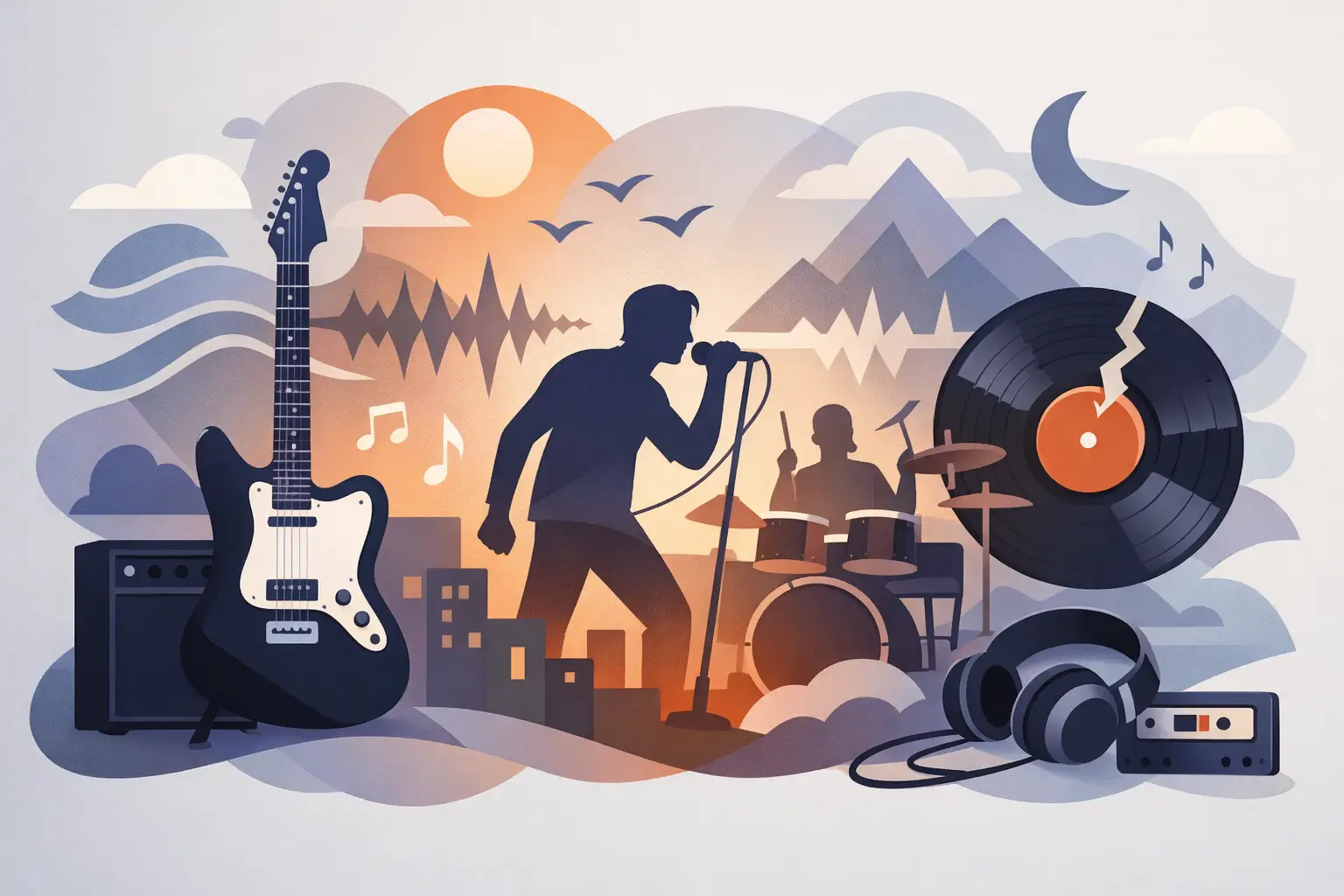
A polished chorus can light up a room, but alternative rock usually does something more lasting – it changes the temperature. It can feel intimate, abrasive, cinematic, detached, vulnerable, or strangely beautiful, sometimes within the same song. That range is the real answer to what makes alternative rock unique: it refuses to stay in one emotional lane or one commercial formula.
Alternative rock has always lived in the tension between accessibility and resistance. It borrows the force of rock music, but it rarely accepts rock at its most predictable. The guitars might be jagged or washed in reverb. The vocals might sound wounded, coolly distant, or barely contained. The production might be raw enough to preserve friction or layered enough to create atmosphere. Even when a track is catchy, there is often something unresolved in it, some edge that keeps it from becoming too neat.
What makes alternative rock unique in sound?
A lot of genres can be identified by a fixed set of musical traits. Alternative rock is different because its identity comes less from one strict sound and more from a mindset. That said, there are sonic patterns that show up again and again.
One of the biggest is contrast. Alternative rock often plays with the push and pull between melody and noise, restraint and release, beauty and dissonance. A verse may feel almost conversational, then open into a chorus that sounds massive without becoming glossy. Guitars can move from clean and spacious to distorted and confrontational in a heartbeat. Drums may sit back and let mood lead the song, or they may hit with a live-wire urgency that gives the track its spine.
That flexibility is part of the appeal. Alternative rock can absorb post-punk tension, punk energy, folk intimacy, shoegaze texture, electronic atmosphere, or classic rock muscle without losing its identity. In fact, that willingness to combine influences is central to its character. The genre tends to reward artists who sound like themselves, not like an industry-approved version of what rock is supposed to be.
Vocals matter here too. In mainstream rock, the vocal often aims for power, polish, or anthem-ready confidence. In alternative rock, the vocal can be more complicated. It may crack, whisper, snarl, drift, or lean into emotional ambiguity. That does not make it less skilled. Often it makes it more believable. Listeners who connect with alternative rock are usually hearing a performance that feels lived-in rather than staged.
It values identity over formula
Alternative rock became culturally significant because it made space for individuality. That sounds obvious now, but it mattered deeply when commercial music systems were rewarding safer repetition. The genre created room for artists who did not fit neatly into glam, arena rock, Top 40 pop, or hard rock conventions.
What makes alternative rock unique is not just that it sounds different. It is that difference is part of the mission. The genre has long embraced artists who write from odd angles, experiment with structure, or leave emotional tension unresolved. Songs do not always land on triumph. Sometimes they linger in confusion, longing, alienation, obsession, or irony. That emotional complexity gives the music staying power.
There is also a visual and cultural dimension. Alternative rock has historically been less interested in perfection and more interested in coherence. The image, the songwriting, the production, and the attitude usually need to feel like they came from the same inner world. Fans can tell when an artist is building a real body of work and when they are simply chasing a trend. That distinction matters in this genre more than in many others.
The emotional honesty feels different
Alternative rock often connects because it allows contradiction. A song can feel detached and deeply emotional at the same time. It can sound beautiful without being comforting. It can hit hard without becoming macho or theatrical.
That emotional honesty is one reason the genre continues to attract album-oriented listeners. Alternative rock tends to reward attention. It invites repeat listens because the songs are not always trying to reveal everything on first contact. A lyric may be suggestive rather than literal. A guitar part may carry as much feeling as the chorus. A production choice may create unease, distance, nostalgia, or momentum without announcing itself.
For listeners who want more than disposable hooks, that subtlety matters. The best alternative rock songs create an atmosphere you can return to, not just a moment you consume once. They feel personal, but not overexplained. Strong, but not overproduced. Crafted, but still alive.
What makes alternative rock unique across eras?
One reason the genre has lasted is that it is not locked to a single decade. People often associate alternative rock with the late 1980s, 1990s, and early 2000s, and for good reason. Those eras produced defining records and shaped the public image of the genre. But alternative rock has survived because its core values are portable.
Every generation finds new ways to reinterpret them. In one era, that might mean louder guitars and rawer edges. In another, it might mean synth textures, ambient production, or hybrid songwriting that moves between indie rock and electronic forms. The tools evolve, but the underlying principle stays recognizable: make something distinct, emotionally real, and resistant to formula.
That is why the label can be both useful and slippery. Alternative rock is broad enough to include very different artists, yet focused enough that listeners still recognize its center of gravity. It does not require one exact tempo, one vocal style, or one production template. It requires conviction. It requires a point of view.
The trade-off is part of the art
Alternative rock is not automatically better than mainstream rock, and pretending otherwise misses the point. Mainstream forms often excel at clarity, immediacy, and wide emotional communication. Alternative rock sometimes chooses texture over instant payoff, ambiguity over certainty, and atmosphere over obvious hooks.
That choice creates strengths, but it also creates trade-offs. Some songs are less immediate. Some records ask more patience from the listener. Some artists become so committed to avoiding convention that they lose melodic focus. Experimentation can produce brilliance, but it can also produce self-indulgence.
Still, when alternative rock works, those risks are exactly what make it compelling. The songs feel earned. They carry marks of personality. They are not smoothed into the same emotional shape as everything else in the playlist.
For independent artists, this matters even more. Alternative rock has always been one of the clearest spaces for musicians to build identity through craft rather than trend alignment. That is part of why so many listeners still seek out artists with a distinct sonic world, whether the music arrives through streaming, direct purchase, or a deeper catalog journey. An independent artist like Nick Duane Music fits naturally into that tradition when the goal is not imitation, but original compositions with passion and excellence.
Why listeners keep coming back
Alternative rock stays relevant because it respects the listener. It assumes people can handle complexity, mixed emotions, imperfect beauty, and songs that do not flatten themselves into easy answers. It invites participation. You do not just hear it. You interpret it, carry it, and revisit it.
There is also a physical quality to great alternative rock that keeps it alive. Even atmospheric tracks tend to have tension in the bones. The rhythm section pulls against the vocal. The guitars create motion, not just decoration. The arrangement leaves room for friction. That sense of movement gives the genre a human pulse, even when the production is highly stylized.
And then there is the question of longevity. Alternative rock ages well when it is rooted in identity rather than novelty. Trends pass. Production fashions change. But songs built on strong writing, emotional truth, and a clear artistic vision tend to outlast their moment. That is why listeners continue to return to records that feel specific instead of generic.
If you are still asking what makes alternative rock unique, the shortest answer is this: it sounds like artists choosing expression over compliance. Sometimes that choice is loud. Sometimes it is subtle. Either way, it leaves a fingerprint. The best alternative rock does not just fill space in your speakers. It creates a world you want to step back into.